Heartburn vs Cardiac Chest Pain: Is it a Heart Attack?
Heartburn vs Cardiac Chest Pain: How to Tell the Signs
Table of Contents
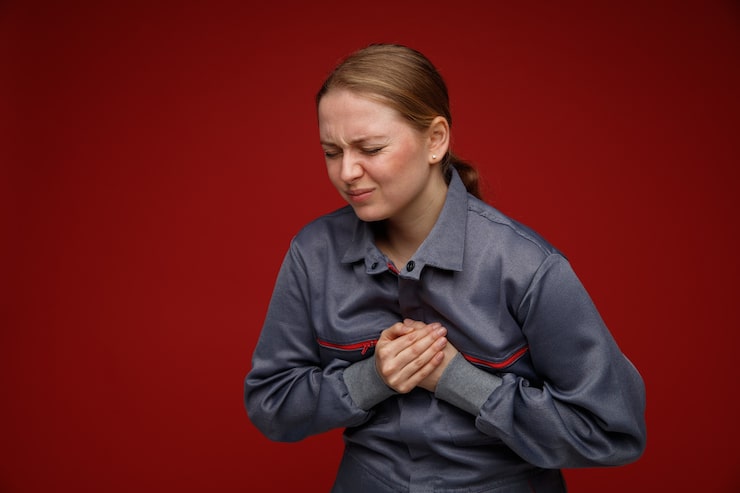
It is 3 a.m. and your chest feels tight. You sit up, sip some water, reach for an antacid and tell yourself the spicy dinner is to blame. Plenty of women have lived this exact moment. The burning behind the breastbone feels like heartburn, so it must be heartburn. Most of the time it is. Now and then it is a heart attack wearing heartburn’s clothes.
That mix-up costs hours. In an AHA News report on the first scientific statement about heart attacks in women, women waited a median of about 54 hours to get treated, compared with 16 hours for men. And in a registry of 1,143,513 heart attack patients, 42 percent of the women had no chest pain at all.
Here is the short version. Heartburn is a burning feeling behind the breastbone that shows up after meals, when you lie flat and when you bend over, and antacids usually calm it.
Cardiac chest pain feels like pressure, squeezing and tightness, can spread to the jaw, arm and back, and can bring sweating, breathlessness and nausea. Symptoms alone cannot settle the question. An ECG and a high-sensitivity troponin blood test do.
Below, I walk through how each one feels, why women get misread more, what an antacid can and cannot tell you, and how doctors settle the question, with the research linked at each step.
What does heartburn feel like?
Heartburn is acid irritation. A ring of muscle at the bottom of your food pipe is meant to stay shut after you swallow. When it relaxes at the wrong moment, stomach acid washes upward and burns the lining, which is why the feeling sits behind the lower breastbone and can climb toward the throat. The condition is called gastroesophageal reflux disease (GERD), and heartburn and regurgitation are its classic symptoms.
- What it feels like. A hot, acidic burn, sometimes with a sour taste at the back of the mouth.
- Where. Behind the lower breastbone, sometimes climbing into the throat.
- What sets it off. Large meals, fatty and spicy food, lying flat soon after eating and bending forward.
- What comes with it. Regurgitation, burping and bloating.
- What eases it. Antacids, sitting upright and time.
Reflux is common, which is exactly why it makes such a good hiding place for a heart problem. A Cleveland Clinic Journal of Medicine review of the 2022 reflux guideline notes that reflux symptoms can overlap with heart and lung disease, so diagnosing it from the description alone is harder than it sounds.
What does cardiac chest pain feel like?
When heart muscle does not get enough blood, it complains. Cardiologists call that complaint angina. A heart attack is what happens when blood flow drops so low that heart muscle starts to die.
Patients describe it as pressure, tightness, squeezing, heaviness and sometimes burning, and the 2021 AHA/ACC chest pain guideline says exactly that. The discomfort can sit in the chest, shoulders, arms, neck, back, upper abdomen and jaw. The same guideline treats those places, along with shortness of breath and fatigue, as anginal equivalents, meaning each one counts as a possible heart symptom even when the chest feels fine.
Burning is not exclusive to heartburn. Heart & Stroke notes that stable angina can feel like the burning of heartburn and indigestion.
Angina and heart attack differ in how long the discomfort lasts and how it responds to rest.
- Stable angina. Comes on with effort, emotional stress, heavy meals and extreme hot and cold weather. It usually lasts about 5 minutes, rarely more than 15, and eases with rest.
- Unstable angina. Can start at rest. The discomfort lasts longer than 20 minutes, does not ease with rest and can get worse over time. It is a warning that a heart attack may be close.
- Heart attack. Heart muscle is being damaged. Heart & Stroke puts the usual length at more than 30 minutes.
Other signs push the odds toward the heart, such as sweating, shortness of breath, nausea, lightheadedness, unusual tiredness and a sense of dread. The AHA lists several of them beside chest discomfort. Some people have no chest pain at all, which the section on women covers below.
Heartburn vs cardiac chest pain, side by side
| Feature | Heartburn | Cardiac chest pain |
|---|---|---|
| Feel | Hot, acidic burn | Pressure, squeezing, tightness and heaviness, and sometimes burning |
| Location | Behind the lower breastbone, climbing toward the throat | Center and left chest, plus the shoulders, arms, neck, back, upper abdomen and jaw |
| Spread | Stops at the throat | Jaw, neck, upper back, shoulder blades and arms |
| Triggers | Large meals, fatty food, lying flat, bending forward | Effort, emotional stress, cold, and sometimes rest and sleep |
| How long | Minutes to a few hours, tied to meals and posture | Stable angina about 5 minutes, heart attack pain longer than 30 minutes |
| Relief | Antacids and sitting upright usually help | Rest eases stable angina, and antacid relief does not rule the heart out |
| Taste | Sour, bitter, regurgitation | None |
| Other symptoms | Burping and bloating | Sweating, breathlessness, nausea, lightheadedness, unusual tiredness and dread |
Read this table as a guide to the odds, not as a test. Women in particular can have heart symptoms that match the left column, which the next section explains. The pattern draws on the 2021 AHA/ACC guideline, the American College of Gastroenterology reflux guideline and Heart & Stroke.
Why are heart attack symptoms in women mistaken for heartburn?
Because women more frequently have heart attack symptoms that look like indigestion, and chest pain is less likely to be the main complaint. Chest pain is still the most common heart attack symptom in women and in men, so the point is not that women never feel it. The point is that a heart attack can arrive without it.
- Heart attacks without chest pain. In a registry of 1,143,513 heart attack patients, 42.0 percent of women and 30.7 percent of men had no chest pain. In-hospital death was 14.6 percent in women and 10.3 percent in men, and younger women who had no chest pain had higher death rates than men their age.
- A different symptom mix. An AHA scientific statement reports that women are less likely than men to have central chest pain and more likely to have upper back, arm, neck and jaw pain, unusual fatigue, breathlessness, indigestion, nausea, vomiting, palpitations, weakness and a sense of dread.
- Symptoms explained away. In the VIRGO study of 2,985 adults aged 18 to 55, chest pain led for both sexes, but women reported more symptoms on top of it and were less likely to be told it was heart related. Younger women were more likely to blame anxiety and stress, and more likely to be misdiagnosed.
- Waiting at home. The same AHA statement ties delays to living alone, reading symptoms as temporary, checking with a family member first, fear and embarrassment. In the AHA News report on it, the median wait for treatment was about 54 hours for women and 16 hours for men.
Not every heart attack in a woman starts with a big, blocking plaque. In some women, especially younger ones, the plaque does not bulge much into the artery, which makes it harder to spot on routine tests, yet it can still form a clot. Spontaneous coronary artery dissection, a tear in the artery wall, is another route, and it turns up in young and middle-aged women who have few usual risk factors. Microvascular disease, which affects the smallest vessels of the heart, also plays a larger part in women than in men.
Do antacids rule out a heart attack?
No. Relief after an antacid does not rule out a heart attack, and relief after nitroglycerin does not confirm one. Both have been used as quick tests in the emergency room, and both have been shown to be unreliable.
- A case review from the AHRQ Patient Safety Network notes that several small studies document partial and complete relief of chest discomfort with antacid solutions in people who have blocked coronary arteries.
- In a 459-patient emergency department study, nitroglycerin relieved pain in 35 percent of patients whose pain came from active coronary disease and in 41 percent of patients whose pain did not. Relief told the doctors almost nothing.
- A review of common chest pain mistakes concludes that the response to a GI cocktail, nitroglycerin and pressing on the chest wall does not reliably identify the source of pain.
An antacid can calm heartburn and still be a coincidence. If the symptoms are new, last more than a few minutes and match the cardiac column in the table, get checked before you take another dose.
What else can cause chest pain?
Heartburn and a heart attack are only two of the possibilities. The 2021 guideline sorts chest pain into cardiac, possibly cardiac and noncardiac, and discourages the older label “atypical” because it is misleading. These are the other usual suspects.
- Esophageal spasm. A squeeze in the food pipe that can mimic angina. Nitroglycerin can relieve it, which is why relief after nitroglycerin proves little.
- Costochondritis. Inflammation where the ribs meet the breastbone. In a prospective study cited in a chest pain review, 6 percent of emergency patients given this diagnosis had a heart attack.
- Panic attack. The same review states that a history of anxiety does not rule out a heart event.
- Other cardiac and lung emergencies. The guideline lists acute aortic syndrome, a blood clot in the lung, inflammation of the heart muscle and lining, and valve disease as causes that doctors check for. It also flags sudden, ripping pain, especially in someone with high blood pressure, as a warning sign.
How do doctors tell the difference between heartburn and a heart attack?
With tests, not with symptoms. Most patients with chest pain turn out not to have a cardiac cause, yet the guideline says every evaluation should aim to find and rule out life-threatening causes early. In one AHRQ review, acute coronary syndrome made up about 15 percent of emergency patients with undifferentiated chest pain.
- ECG. A quick tracing of the heart’s electrical activity. The guideline calls the ECG important in acute and stable chest pain to check for acute coronary syndrome.
- High-sensitivity troponin. Troponin is a protein that leaks into the blood when heart muscle is injured. This test is the preferred standard for diagnosing a heart attack because it detects and rules out injury more accurately.
- Risk pathway. Doctors score each patient’s risk. Among patients with acute chest pain and a 30-day risk of a major cardiac event, including death, under 1 percent, no further urgent cardiac testing may be needed.
- Imaging for stable chest pain. Patients at intermediate-high risk with no known coronary disease may have coronary CT angiography to diagnose blockages and stress imaging to check blood flow.
- Reflux testing after the heart is cleared. For chest pain without heartburn, the American College of Gastroenterology guideline says reflux testing can be considered once cardiac testing is negative.
Who should not assume it is heartburn?
Anyone with new chest symptoms and a risk factor for heart disease, and women in particular, because several risks are easy to miss.
- High blood pressure and diabetes. Both raise heart attack risk more sharply in women than in men.
- Pregnancy complications. An AHA statement links preeclampsia to a 2.7 times higher risk of later cardiovascular disease, gestational diabetes to a 68 percent higher risk and gestational hypertension to a 67 percent higher risk, even when the pregnancy was decades ago.
- Depression. Depressed women have a 50 percent higher risk of heart attack.
- A clean risk profile. A tear in the artery wall can cause a heart attack in young women who have few usual risk factors, so normal cholesterol and blood pressure do not clear the chest.
- Pain that changes. Discomfort that starts at rest, lasts longer and gets worse over time points to unstable angina, which needs urgent care.
Frequently asked questions
Can heartburn feel like a heart attack?
Yes. Burning, nausea and upper abdominal discomfort can show up with both, and the 2021 guideline lists burning among the ways patients describe cardiac pain. That overlap is why doctors check an ECG and troponin first, and why the reflux guideline says reflux testing can be considered for chest pain without heartburn once cardiac testing is negative.
How long does heartburn last compared with a heart attack?
Heartburn tends to come and go with meals and posture, lasting minutes to a few hours. Stable angina usually lasts about 5 minutes and rarely more than 15, while heart attack pain generally lasts more than 30 minutes. Duration helps sort the odds, but it cannot rule out the heart.
Can a heart attack feel like indigestion?
Yes. Indigestion, nausea and pain in the upper back, arm, neck and jaw occur more frequently in women having a heart attack than in men. The 2021 guideline counts upper abdominal discomfort as a possible heart symptom, so new indigestion in someone with risk factors deserves a medical check.
Can you have a heart attack with no chest pain?
Yes. In a registry of 1,143,513 heart attack patients, 42.0 percent of women and 30.7 percent of men had no chest pain. Shortness of breath, nausea, fatigue and pain in the jaw, back and arm can be the main symptoms.
Is left-sided chest pain always the heart?
No, and a chest wall diagnosis does not clear the heart either. In a prospective study cited in a chest pain review, 6 percent of emergency patients diagnosed with costochondritis had a heart attack. Location alone cannot sort the cause, because the guideline counts the shoulders, arms, neck, back, upper abdomen and jaw as possible sites of heart pain.
Sources
- 2021 AHA/ACC/ASE/CHEST/SAEM/SCCT/SCMR Guideline for the Evaluation and Diagnosis of Chest Pain, Circulation, 2021, with the ACC key points and AHA top things to know
- ACG Clinical Guideline for the Diagnosis and Management of Gastroesophageal Reflux Disease, American Journal of Gastroenterology, 2022
- Canto et al., JAMA, 2012, heart attack symptom presentation by age and sex
- Lichtman et al., Circulation, 2018, the VIRGO study of symptoms in young patients
- Mehta et al., Circulation, 2016, AHA scientific statement on heart attack in women
- Hayes et al., Circulation, 2018, AHA scientific statement on spontaneous coronary artery dissection
- Henrikson et al., Annals of Internal Medicine, 2003, nitroglycerin response and coronary disease, as summarized in American Family Physician
- AHA statement on adverse pregnancy outcomes, 2021
- AHRQ Patient Safety Network case review
- Cleveland Clinic Journal of Medicine review of the 2022 reflux guideline
- Chest pain, 10 common myths and mistakes, Patient Care, 2007
- Heart & Stroke, angina
- AHA, heart attack symptoms in women
- Yale School of Public Health on VIRGO findings
- AHA News on heart attacks in women